
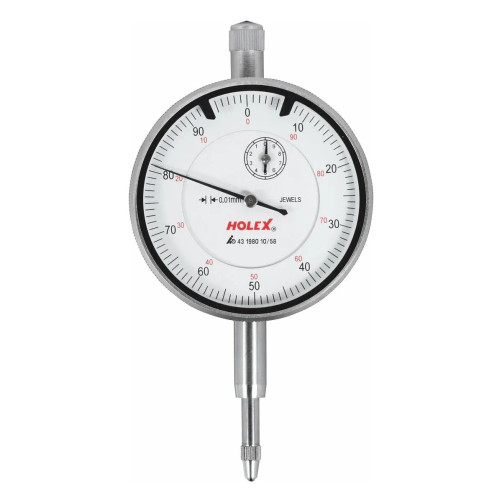

Holex Dial Indicator 10/58 mm
Version:
Dimensions to DIN EN ISO 463, issue June 2006. Precision dial indicators with metal housing, clamping shank ⌀ 8 mm h6, hardened and ground. Outer ring of dial face can be rotated to zero the dial. Central pointer for 1/100 mm reading, small pointer on sub-scale for 1 mm reading.
Outer ring with 2 adjustable tolerance pointers.
Outer ring with 2 adjustable tolerance pointers.
Optional extras:
Technical Data
| Standard | DIN 878 | |
| Measuring range | 10 mm | |
| Graduation | 0.01 mm | |
| Reading per pointer revolution | 1 mm | |
| Measurement variation MPE (measurement range) | 15 µm | |
| Gauging force | 0.4 N - 1.4 N | |
| Measurement technology | analogue | |
| Body ⌀ | 58 mm | |
| Packaging | sturdy box | |
| Type of product | dial gauge |
Identification numbers & Classifications
| Article number | 431980 10/58 | |
| EAN / GTIN | 4045197204165 | |
| Manufacturer number | 431980 10/58 |
Dial Indicators VS Digital Indicators
Both dial and digital indicators have their unique advantages and cater to different user preferences and applications.Dial Indicators are known for their mechanical simplicity and reliability. They feature a dial face with a central pointer that displays measurements through a graduated scale. Users often appreciate the tactile feedback and straightforward operation, making them ideal for quick visual assessments. Skilled operators can "split grads," enabling them to estimate measurements with a degree of accuracy beyond the indicated value. This ability allows for immediate interpretation of measurement trends, which can be crucial in various applications. Moreover, dial indicators do not rely on batteries and can last indefinitely with proper care, though they may require more frequent cleaning and maintenance.
In contrast, Digital Indicator have emerged as the go-to choice in many modern settings, especially for data collection and process control applications. They eliminate the potential for human error associated with reading and recording measurements, as values are displayed digitally and can often be output directly to computers or printers. With features such as auto-zeroing, unit conversion, and data logging, digital indicators provide enhanced functionality and precision. Many digital models now offer supplementary analog displays, combining the benefits of both worlds. They are becoming increasingly affordable, making them competitive with high-quality dial indicators.
Ultimately, the choice between dial and digital indicators depends on the specific requirements of the application and the user’s familiarity with the tools. As digital technology continues to advance, it is clear that digital indicators are gaining traction, especially among new generations of operators who are accustomed to digital interfaces. However, dial indicators maintain a loyal following due to their reliability and ease of use. Both types have their place in precision measurement, and understanding their strengths can help users make informed decisions based on their needs.



 Sign up for newsletter